

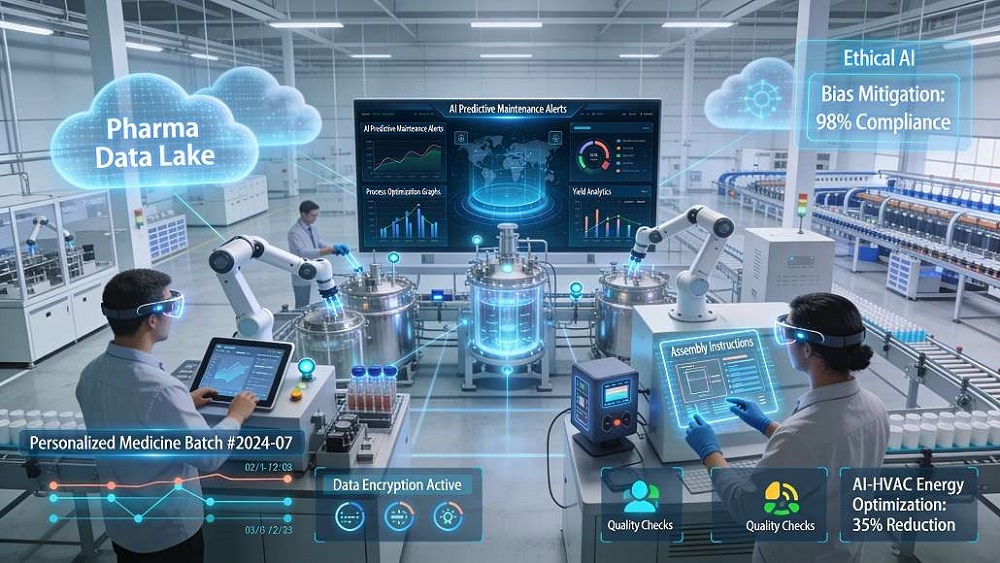
The pharmaceutical sector is experiencing an unprecedented era of transformation. Historically reliant on long, linear discovery timelines and rigid manufacturing paradigms, the industry is rapidly shifting toward agile, data-driven, and highly patient-centric models. This evolution is vital. The modern healthcare environment demands faster responses to emerging pathogens, more effective treatments for chronic illnesses, and scalable ways to reduce the cost of delivering complex therapies. Driven by breakthroughs in computational science, cellular biology, and advanced engineering, several core technological pillars are reshaping how therapies are conceived, developed, and distributed globally.
Artificial Intelligence and Machine Learning in Drug Discovery
The traditional process of bringing a new drug to market takes over a decade and requires immense capital investment, with a high percentage of candidate molecules failing during clinical trials. Artificial intelligence and machine learning are fundamentally altering this dynamic by shifting drug discovery from a process of physical trial-and-error to one of predictive digital modeling.
Deep learning frameworks excel at analyzing massive biological datasets, including genomic sequences, proteomic structures, and historical clinical data. By recognizing intricate molecular patterns that elude human analysis, predictive algorithms can identify viable therapeutic targets and design novel small molecules from scratch. This process, known as de novo molecular design, allows researchers to simulate how billions of chemical compounds will interact with specific disease-causing proteins before any physical synthesis occurs in a laboratory.
Beyond target identification, machine learning optimizes the optimization phase of lead compounds. Algorithms can simultaneously predict a molecule’s binding affinity, metabolic stability, toxicity, and synthetic accessibility. By filtering out unviable options early in the computational phase, pharmaceutical firms save years of laboratory work and reduce preclinical development costs by orders of magnitude.
Precision Medicine and Advanced Genomics
For decades, the standard pharmaceutical model relied on blockbuster drugs designed to treat broad patient populations based on generalized symptoms. However, different individuals often exhibit vastly divergent responses to the identical medication due to variations in their genetic architecture. Precision medicine shifts the paradigm by tailoring preventive measures and therapeutic interventions to the genetic, environmental, and lifestyle profile of the individual patient.
High-throughput next-generation sequencing has made mapping a patient’s entire genome economically viable and routine. In oncology, this enables physicians to sequence the DNA of a specific tumor and identify the exact mutations driving its malignancy. Armed with this genetic profile, pharmaceutical companies develop targeted therapies that selectively destroy malignant cells while sparing healthy tissue, mitigating the severe adverse effects associated with conventional chemotherapy.
Furthermore, pharmacogenomics, the study of how genes affect a person’s response to drugs, is becoming integral to the development process. By screening patients for specific genetic biomarkers during clinical development, researchers can determine beforehand who will benefit from a therapy and who might experience an adverse drug reaction. This stratification leads to smaller, more statistically powerful clinical trials, accelerating regulatory approvals and improving patient safety outcomes in clinical practice.
Advanced Manufacturing Modalities
The transition toward complex biological drugs, such as monoclonal antibodies, cell therapies, and messenger RNA vaccines, has strained traditional batch manufacturing frameworks. In response, the industry is adopting next-generation production methodologies that maximize throughput, ensure uncompromising quality control, and allow for rapid scalability.
Continuous manufacturing represents a departure from traditional batch processing, where materials move through discrete, separated steps over days or weeks. In a continuous system, raw materials are fed uninterrupted into an automated facility, undergoing formulation, blending, and tableting or filling in a single, continuous stream. This methodology reduces the physical footprint required for production facilities, minimizes human intervention, and eliminates the risk of batch-to-batch variations. Integrated analytical sensors monitor the product quality in real-time, allowing for instant adjustments and preventing the waste of entire production runs.
Concurrently, additive manufacturing, or three-dimensional printing, is altering drug delivery mechanisms. By using specialized printers, pharmaceutical companies can produce personalized solid oral doses with precise, complex internal structures. This allows for customized release profiles, such as a single pill that releases different active ingredients at distinct intervals throughout the day, or highly porous tablets that dissolve instantly for patients who struggle with swallowing traditional medications.
Decentralized Clinical Trials and Digital Biomarkers
Clinical trials are the bottleneck of pharmaceutical commercialization, frequently plagued by patient recruitment delays, low retention rates, and geographically restrictive testing centers. The integration of digital health technologies is dismantling these geographic barriers, moving trials away from centralized hospital hubs directly into patients’ homes.
Decentralized clinical trials leverage remote monitoring tools, wearable medical devices, and telemedicine platforms to gather continuous, real-world patient data. Rather than requiring participants to travel long distances to an academic medical center for periodic check-ups, continuous streams of physiological data, such as heart rate, blood glucose, sleep architecture, and oxygen saturation, are securely transmitted to clinical investigators.
This continuous data collection provides a clearer picture of a drug’s therapeutic efficacy and safety profile in everyday life, rather than relying on isolated snapshots taken in a stressful clinic environment. Digital biomarkers, objective quantified physiological and behavioral data gathered by biosensors, allow for early detection of subtle therapeutic responses or adverse events. This approach widens the pool of diverse trial participants, enhances retention rates, and reduces the time needed to compile regulatory submission portfolios.
Cell and Gene Therapies
While traditional small-molecule drugs manage chronic diseases by addressing symptoms, cell and gene therapies aim to cure diseases at their cellular and genetic roots. These therapeutic classes represent a profound shift from lifelong chronic disease management to potentially curative single-dose interventions.
Gene therapies utilize engineered viral vectors or precise gene-editing tools like CRISPR-Cas9 to deliver functional copies of genes directly into a patient’s cells, replacing mutated or non-functional DNA. This approach is curing rare, inherited genetic conditions like spinal muscular atrophy and certain forms of congenital blindness, which previously lacked effective treatment options.
Cellular therapies, particularly Chimeric Antigen Receptor T-cell therapy, involve extracting a patient’s immune cells, genetically modifying them in a laboratory to recognize and attack specific cancer antigens, and reinfusing them into the patient. This living drug approach has achieved durable remission rates in patients with advanced hematological malignancies, driving massive investment into scaling the complex autologous supply chains required to handle sensitive biological materials safely.
Supply Chain Digitalization and Blockchain Technology
The global pharmaceutical supply chain is extraordinarily complex, requiring temperature-controlled logistics for sensitive biologics and rigorous safeguards against counterfeit medications. Digitalization is embedding transparency, traceability, and resilience into these global distribution networks.
Internet of Things sensors are deployed across cold chain logistics networks to monitor environmental variables like temperature, humidity, and vibration in real-time during transit. If a shipment of temperature-sensitive vaccines deviates from its validated storage range, automated alerts allow logistics managers to intervene immediately, preventing the loss of valuable inventory.
Simultaneously, blockchain technology is securing the chain of custody for pharmaceutical products from the raw ingredient supplier to the dispensing pharmacy. Because a blockchain creates an immutable, cryptographically secure ledger of every transaction and transfer, it prevents counterfeit drugs from infiltrating legitimate distribution networks. This compliance fulfills stringent global regulatory requirements, protects brand integrity, and safeguards public health.
FAQ
How does continuous manufacturing improve the sustainability of pharmaceutical production?
Continuous manufacturing significantly minimizes environmental impact by optimizing material efficiency and lowering overall energy demands. Traditional batch manufacturing requires substantial energy to heat, cool, and clean massive holding tanks between separate production steps, and creates material waste during adjustments. Continuous systems utilize a compact, integrated setup that runs constantly, decreasing the physical footprint of the factory, reducing solvent use, and lowering greenhouse gas emissions.
What role does natural language processing play in modern pharmaceutical research?
Natural language processing algorithms scan millions of unstructured scientific papers, clinical trial registries, patents, and electronic health records globally. By analyzing this vast repository of text, the software identifies hidden connections between disparate biomedical findings, such as an existing drug for one condition showing potential efficacy against an unrelated disease, thereby accelerating drug repurposing strategies.
What are digital twins and how are they applied in the pharmaceutical sector?
A digital twin is a dynamic, virtual replica of a physical asset, process, or system. In pharmaceuticals, engineers construct digital twins of manufacturing processes to simulate how variations in raw materials or ambient conditions will alter the final product quality without running physical tests. Researchers are also developing digital twins of human biological systems to simulate drug distribution and metabolic pathways within a virtual patient population before initiating human clinical trials.
How do modern pharmaceutical companies protect patient privacy in decentralized clinical trials?
Decentralized trials employ advanced cryptographic techniques, including homomorphic encryption and federated learning models. These systems allow algorithms to analyze patient physiological data and extract therapeutic insights without revealing the patient’s underlying identity or sensitive personal identifiers to unauthorized parties, ensuring strict compliance with evolving global data protection laws.
Why are companion diagnostics critical to the commercial success of targeted therapies?
Companion diagnostics are specific laboratory assays designed to detect distinct genetic biomarkers in a patient before a drug is prescribed. By proving that a specific patient possesses the biological target that a drug is engineered to hit, these diagnostic tools provide regulatory bodies and insurance providers with concrete evidence that the treatment will be effective, facilitating faster market access and reimbursement approvals.
What is the difference between autologous and allogeneic cell therapies?
Autologous cell therapies utilize a patient’s own biological cells as the starting material, which are extracted, modified in a lab, and reinfused. While highly effective, this method requires a complex, custom manufacturing cycle for every single patient. Allogeneic therapies, by contrast, utilize healthy donor cells to manufacture standardized, mass-produced batches that can be stored at medical centers and administered immediately to any matching patient, dramatically reducing production costs and delivery times.
How does automated visual inspection enhance quality control in vaccine packaging?
Automated visual inspection systems utilize high-speed cameras coupled with computer vision algorithms to evaluate glass vials and syringes on the assembly line at speeds exceeding hundreds of units per minute. These systems instantly detect microscopic structural fractures, particulate contamination within the liquid, and improper stopper alignments that are impossible for human inspectors to reliably catch, eliminating compromised products before distribution.